The arc flash PPE category method is the table-based path in NFPA 70E for selecting arc-rated clothing and gear without calculating an incident energy value for the equipment. You look up the task and the equipment in Table 130.7(C)(15)(a) for AC systems or Table 130.7(C)(15)(b) for DC systems, read off a PPE Category of 1 through 4, then use Table 130.7(C)(15)(c) to turn that category into the specific garments and equipment the worker wears. NFPA 70E gives an employer exactly two compliant ways to select arc flash PPE, this one and an incident energy analysis, and the two may not be mixed on the same piece of equipment.
Picture a plant engineer at a wastewater treatment plant with a work order to rack out a starter in a motor control center. She has two lawful ways to dress the electrician doing that job. She picks one, and that piece of gear stays on that method.
How does the category method actually work?
Three tables, used in order. Table 130.7(C)(15)(a) assigns a PPE Category to AC tasks by equipment type and the work being done. Table 130.7(C)(15)(b) does the same for DC systems. Table 130.7(C)(15)(c) then translates the category number into the arc-rated clothing and other protective equipment required. The category belongs to a task on a specific piece of equipment, not to a room or a building.
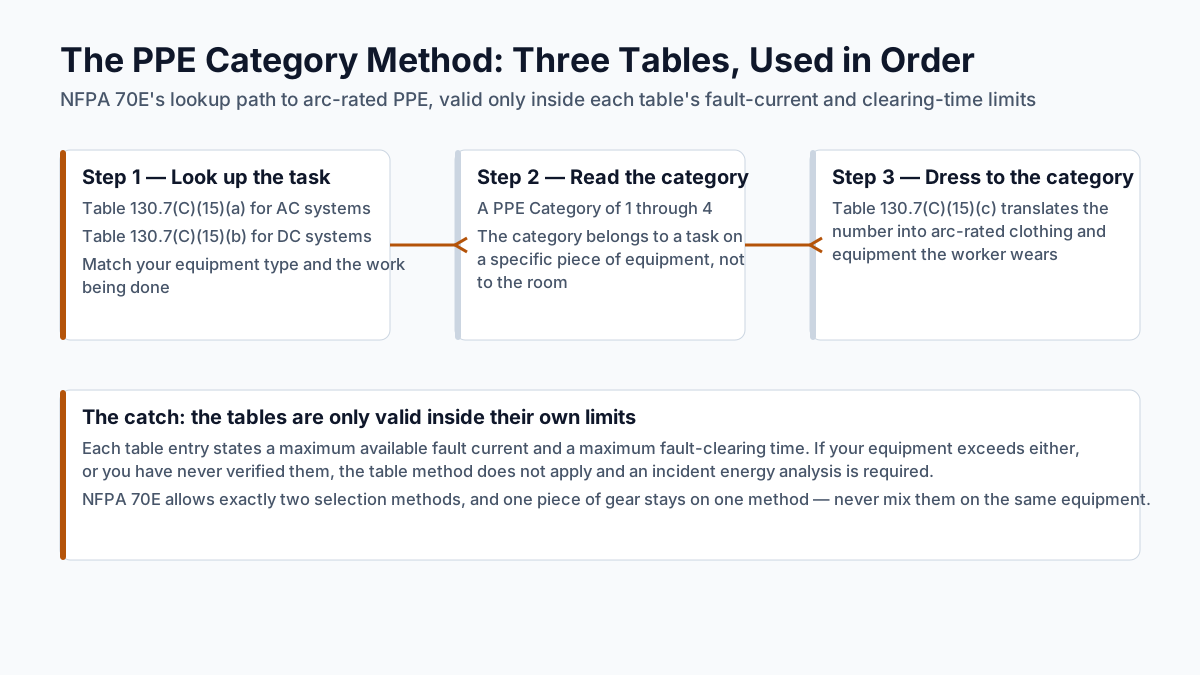
That last point catches people. Two electricians working the same lineup on the same afternoon can land in different categories, because opening a hinged cover for visual inspection and racking a breaker in and out are different tasks with different exposure.
The DC table exists because DC installations are common in facilities that never think of themselves as DC sites. A data center with a battery plant behind its uninterruptible power supply, the bank of batteries that carries the load for the minutes between a utility dip and a generator picking up, is a DC system with its own fault behavior. Substation station-battery cabinets land there too. Reaching for the AC table on that equipment misapplies the method.
When can you use the tables instead of a calculated study?
Only when the equipment sits inside the parameters the table states for it. Each row carries a maximum available fault current and a maximum fault-clearing time for that equipment type, and the category is valid only under those limits. Both numbers have a defined source. Available fault current comes from a short-circuit study of the system as it is fed today. Clearing time comes from the protective device ahead of the work, at the settings it is actually carrying right now.
Jim Phillips, P.E., Vice-Chair of the IEEE 1584 Arc Flash Working Group and a member of the NFPA 70E Technical Committee, puts the reason plainly: "Fault current and clearing time are the two main variables that define the severity of an arc flash." Get either one wrong and the table hands you a confident answer to the wrong question.
This is where Florida facilities drift out of the method without noticing. A plant running on rental generation and temporary feeders after a storm is not fed the way it was the week before the storm, and available fault current moves with the source. Relay and trip-unit settings drift the same way. Somebody raises a pickup to stop nuisance trips during a hot August, the change never gets restudied, and clearing time is now longer than the table assumed when the category was assigned.
None of that makes the tables second-rate. As Phillips writes, "In the absence of incident energy calculations, the tables remain a good alternative. Just don't ignore the parameters." The method earns its answer when the two numbers behind it have been verified for that equipment, and it stops being a method when they haven't.
Category method or incident energy analysis: which one fits your gear?
The table method suits facilities where the equipment is ordinary, the parameters are known and inside the limits, and nobody needs a number on the wall. An incident energy analysis suits everything else, and it is where most facilities end up once equipment falls outside the table's bounds. Here is the practical split.
| Arc flash PPE category method | Incident energy analysis | |
|---|---|---|
| How PPE gets selected | Task and equipment looked up in Table 130.7(C)(15)(a) for AC or (b) for DC | Engineering calculation of incident energy at a working distance |
| What you get | A PPE Category, 1 through 4, converted to garments by Table 130.7(C)(15)(c) | A calculated value in cal/cm², plus the arc flash boundary |
| What it demands of your data | Verified available fault current and clearing time inside the table's stated limits | A modeled system: short-circuit study, device coordination, field-verified settings |
| Where it stops | No calculated cal/cm² value for that equipment | IEEE 1584-2018 covers three-phase AC from 208 V to 15 kV and excludes single-phase AC, DC, and PPE recommendations |
IEEE 1584-2018 is the engineering method behind that right-hand column, and it defines the arc flash boundary as the distance at which incident energy equals 1.2 cal/cm². How to read the analysis section of a study report, and which field inputs drive the calculated number, are subjects of their own.
Either path still leaves you with labels. NFPA 70E 130.5(H) requires equipment likely to be worked on energized to carry a label, and the 2021 edition added a durability requirement for the labels themselves, meaning the label has to survive the environment it lives in. Labels are also where Florida's climate defeats off-the-shelf label stock. A thermal-transfer label that looks fine on a shop bench chalks and fades on a switchgear door in a west-facing electrical room, curls in a chlorine contact building that gets hosed down every shift, and lifts at the corners in salt aerosol a mile from open water. A label nobody can read is a label the standard does not credit you for.
What does OSHA require if NFPA 70E is not law?
OSHA has not adopted NFPA 70E through rulemaking, so no inspector cites you for violating a table number. The hook is 29 CFR 1910.132(d), which requires employers to assess the workplace for hazards that make PPE necessary, select PPE that protects against what the assessment found, and document that assessment in a written certification naming the workplace evaluated, the person certifying it, and the date. Either NFPA 70E method satisfies that in practice.
OSHA's own 2006 standard interpretation letter sets the relationship out: the agency recommends consulting NFPA 70E for arc flash safety measures as consensus guidance, and states it will not invoke the General Duty Clause, Section 5(a)(1), the catch-all rule requiring a workplace free of recognized hazards, to enforce NFPA provisions where an existing OSHA standard such as 29 CFR 1910.335 already covers the hazard. So the standard tends to show up after an incident, a complaint, or an insurance audit, which is why plenty of facilities find out their program is thin at the worst possible moment.
One more limit matters here: a PPE Category covers thermal burn protection and nothing else. It says nothing about shock, which is handled by voltage-rated rubber insulating gloves and the shock protection rules that go with them. It says nothing about arc blast pressure, which is managed through working distance and engineering controls. Confined space entry, fall protection, and atmospheric hazards like oxygen deficiency or toxic gas sit outside the category entirely. The category is one output of a hazard analysis, not a replacement for the electrical safety program around it.
If your parameters have never been established, or the facility has changed since they were, Arc Flash Florida handles the whole job in one engagement, including building the one-line diagram when a plant no longer has a current one. Whichever method your equipment ends up on, the answer is only as good as the two numbers underneath it.
Frequently asked questions
What are the 7 categories of PPE?
NFPA 70E has no seven-category list. Its arc flash PPE categories run 1 through 4, assigned by Table 130.7(C)(15)(a) for AC systems and Table 130.7(C)(15)(b) for DC systems. Lists of seven PPE "categories" grouped by body region come from general workplace PPE discussions, not from the arc flash tables in NFPA 70E.
What is the arc flash suit Category 4?
Category 4 is the highest of the four arc flash PPE categories the NFPA 70E table method can assign. For the exact garments and protective equipment that row requires, read the Category 4 row of Table 130.7(C)(15)(c) in the edition your electrical safety program is built on. Note that the table method never produces a cal/cm² value for that equipment.
When using the arc flash PPE category table method for arc flash risk assessment, you must?
You must confirm the equipment's available fault current and fault-clearing time fall inside the limits the table states for that task and equipment type. Available fault current comes from a short-circuit study of the system as it is fed today, and clearing time comes from the protective device at its present settings. You also may not mix the table method with an incident energy analysis on the same piece of equipment.
Is arc flash PPE category 0 still required?
The current NFPA 70E arc flash PPE category tables assign Categories 1 through 4, so there is no Category 0 to select from Table 130.7(C)(15)(a) or (b). Shock protection, such as voltage-rated rubber insulating gloves, is still driven by the task's shock hazard regardless of which arc flash category applies.
Sources reviewed
- IEEE Std 1584-2018 — Guide for Performing Arc-Flash Hazard Calculations (official standard page) IEEE 1584-2018 defines the incident-energy calculation method used by the incident energy analysis option; scope is 3-phase AC, 208V-15kV; published Nov 30, 2018; excludes single-phase, DC, and PPE recommendations.
- NFPA 70E free-access portal (2024 edition) Official free-access point for the current (2024) edition full text — use to verify any specific section number before publishing (e.g., resolve the 130.5(F)/(G) split noted above).
- OSHA 29 CFR 1910.132(d) — Hazard Assessment and Equipment Selection Employers must assess the workplace for PPE-necessitating hazards, select PPE accordingly, and document the assessment in writing (workplace, certifier, date).
- OSHA Standard Interpretation Letter, Nov. 14, 2006 — arc-flash warnings, FR clothing, and NFPA 70E OSHA treats NFPA 70E as consensus guidance it has not adopted through rulemaking, and will not use the General Duty Clause to enforce NFPA 70E when an existing OSHA standard already covers the hazard.
- Jim Phillips, P.E. — 'Don't Ignore the Parameters: Arc Flash PPE Category Tables' (LinkedIn repost of his Electrical Contractor magazine column) Fault current and clearing time are the two variables that define arc-flash severity and must be verified before relying on the PPE category tables; original publication in Electrical Contractor Magazine (NECA), ~Jan 2023.
- EC&M / Electrical Contractor summaries of NFPA 70E 2021 revision documents (Table 130.7(C)(15) stability across editions) Confirms Table 130.7(C)(15)(a) and (b) (AC/DC PPE category tables) persisted with only note-level edits across the 2018→2021→2024 editions; used only to corroborate table numbering, not as the authority for standard text itself.