An arc flash study has to be reviewed for accuracy at least every five years, and updated sooner than that any time a change to your electrical distribution system could change the results. Five years is the outside limit, and it comes from Article 130.5 of NFPA 70E, the workplace electrical safety standard, the section that governs the arc flash risk assessment. What gets reviewed is the incident energy analysis, the calculation of how much heat energy an arc would put on a worker standing a set distance from the equipment. That number is printed on the warning labels bolted to your equipment doors, and it decides what protective clothing and gear (PPE) a worker has to wear to open them.
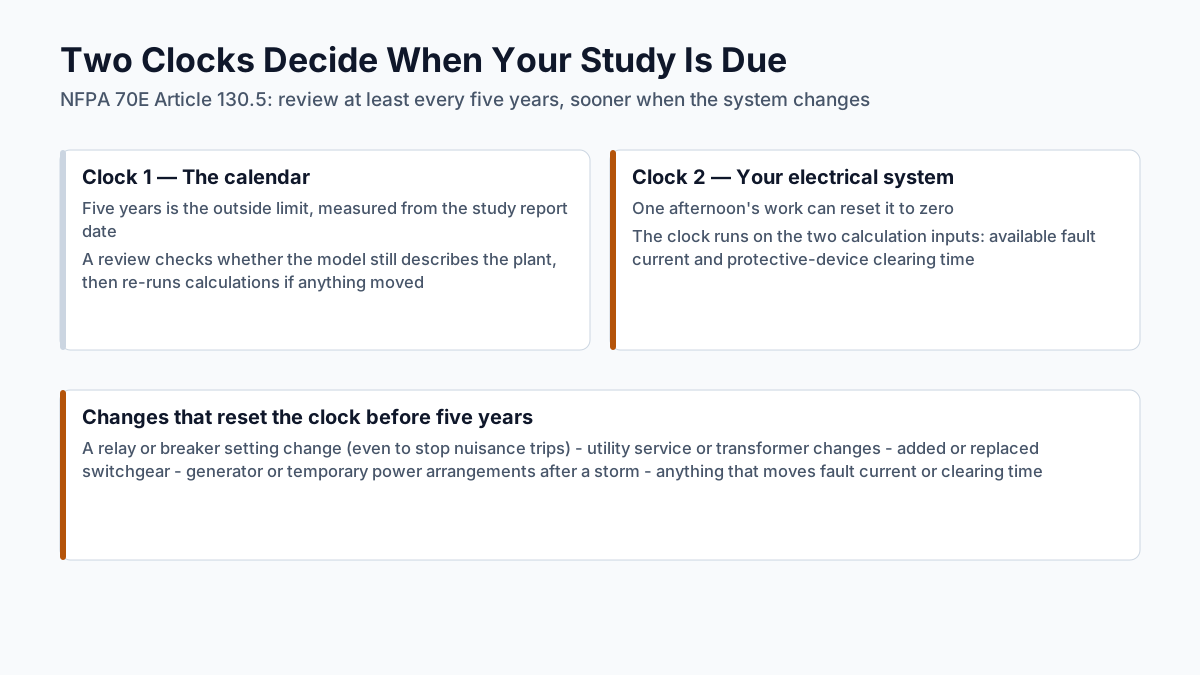
Two clocks run at once. One is the calendar, and it gives you five years. The other runs on your electrical system, and one afternoon's work can reset it to zero.
Picture a plant manager in Tampa whose study report is dated 2023, well inside the five years. Last spring a relay technician raised the pickup setting on a main breaker to stop nuisance trips on a chiller, and that setting decides how fast the breaker opens during a fault. Incident energy depends on just two things: how much fault current is available, and how fast the protective device clears the fault. He changed the second one. Her labels went out of date the afternoon the technician closed that cabinet, and nothing about them looks any different.
What does NFPA 70E say about the five-year interval?
The standard requires the incident energy analysis behind the arc flash risk assessment to be reviewed for accuracy at intervals not to exceed five years, and updated whenever changes in the electrical distribution system could affect the results. NFPA sells the standard rather than publishing its text, so the clause language reaches the public through the people who write it. Jim Phillips, P.E., who sits on the NFPA 70E technical committee, quotes its exact wording and places the review clause at subsection 130.5(G), the provision covering the incident energy analysis method.
Article 130.5 is the citation to rely on. The (G) letter comes from a committee member, not from NFPA's own published pages.
What changes reset the clock before five years?
Incident energy is calculated from two inputs: the fault current available at a piece of equipment, and how long the protective device upstream takes to clear a fault there. Both inputs are tracked in two places: the one-line diagram, the single-page map of how power flows from the utility through every transformer, breaker, and bus in your building, and the computer model built from that diagram, which is where the calculations actually run. Anything that moves either input moves the calculated value, and the label stops matching the equipment the moment it does.
| What changed | Why it moves the number | What is now out of date |
|---|---|---|
| A transformer is replaced or resized | Available fault current changes at everything it feeds | Every label downstream of it |
| Protective device settings are adjusted (relay pickup, time dial, a fuse swapped for a different class) | Clearing time changes | Labels on that bus and everything below it |
| New panels, motor control centers, or large motors are added | New buses appear, and running motors feed current into a fault | The one-line diagram and the model built from it |
| The utility changes the service feeding your building | Fault current at your service is the starting value for the whole study | Every calculated value in the report |
| Damaged equipment is replaced | The new device has its own interrupting rating and its own trip curve | Model inputs for that device, and its label |
Two terms in that last row need pinning down. A device's interrupting rating is the largest fault current it can break safely. Its trip curve is the graph of how quickly it opens at each level of current, and that curve is what the model reads to work out clearing time. Swap a breaker for a different make or frame and both can change, even when the new unit fits the same cubicle.
Move either input far enough and a piece of equipment lands at a higher hazard level, meaning heavier protective gear is required to work on it, while the label on its door still shows the old number.
Does a five-year review mean a whole new study?
A five-year review is not automatically a new study. It is a check on whether the model still describes the plant, followed by a re-run of the calculations if anything has moved. How much work that takes depends on how well the last five years were documented.
If the one-line diagram is current, and someone kept a record of electrical changes, the review can be a walk-down, an engineer walking the plant and checking gear against the model, that confirms it in a day. If nobody tracked the changes, field data collection starts over: nameplates, settings, conductor sizes.
Keeping that record is work your own maintenance and safety staff can own. Turning it into incident energy values takes qualified engineering analysis.
Why can a Florida study go stale before five years are up?
After a hurricane, a study can go wrong without anything visible happening to it. The labels stay bolted on and stay legible. The system they describe is what moved.
Start with replacement. When storm-damaged switchgear comes out and a new unit goes in, the replacement carries its own interrupting rating and its own trip curve. The label on that door now describes a device that is no longer in the enclosure.
Corrosion feeds the same chain on a slower schedule. Salt-laden air attacks contacts, bus bar, and relay terminals in coastal equipment rooms, and corrosion is one of the reasons a device gets replaced instead of repaired. A replacement device brings trip characteristics the model has never seen, so the model's clearing time for it is wrong from the moment it is energized.
Temporary and standby power does it differently. A generator or a temporary feeder brought in during an outage adds a source to a bus, and a bus fed from two sources has a fault-current value the study never calculated. While that setup is live, the label describes only the utility-fed case.
Your utility's own work counts too. If it reconductors a feeder, meaning it strings larger conductors on the line, or swaps a substation transformer, the fault current arriving at your service can change. Nothing inside your fence has to move for the starting value of your study to become wrong.
None of that sends anyone a notice. It surfaces at the next review, and by then the label may have been wrong since the season that switchgear was replaced.
All of that is a study going stale. What forces a facility to commission one in the first place, from energized work that cannot be de-energized to an insurance carrier's demand, is a separate question, and one we answer in its own post.
Does OSHA set the interval?
OSHA publishes no five-year arc flash interval. NFPA 70E is a voluntary, ANSI-approved consensus standard, not a federal regulation. OSHA enforces the underlying duty through Section 5(a)(1) of the OSH Act, which requires employers to furnish a workplace "free from recognized hazards that are causing or are likely to cause death or serious physical harm," and through the PPE hazard assessment rule at 29 CFR 1910.132(d), which makes an employer assess the workplace for hazards that call for PPE and document that assessment. In a 2003 interpretation letter, OSHA stated it can use NFPA 70E as evidence of a recognized hazard.
Small facilities sometimes read all of this as a big-plant rule. Christopher Coache, NFPA Senior Electrical Engineer, says otherwise: "OSHA's goal is to have employers provide all workers a place of employment free from recognized hazards to safety and health. This is true whether the employer is a two-man shop or a 30,000-employee corporation and regardless of the industry."
One more date confuses people here. The standard itself gets rewritten on its own schedule, separate from your review clock. NFPA 70E is revised on a three-year cycle. The 2024 edition was issued April 23, 2023 and took effect May 13, 2023, and the 2027 edition was issued April 16, 2026. OSHA and your insurance carrier look at the edition in force today, whatever edition your written electrical safety program was based on.
Where does the five-year clock actually start?
It starts at the date of the study report. NFPA 70E does not require a date on the label at all: section 130.5(H) sets out what an arc flash equipment label has to show, and Jim Phillips notes that the section's wording never mentions adding a date. Labels that carry one carry it because the owner or the firm doing the study chose to put it there.
Because nothing obliges the label to carry a date, the report is usually the only record of when the clock started. A page in a binder covers the rest. Keep a running log of anything that touches a protective device, a transformer, or a source of power: date, equipment, what changed, who did it. Hand that log to the engineer at review time and the review is a confirmation. Without it, the review is a reconstruction.
Arc Flash Florida handles the whole job in one engagement, field data collection through engineering, labels, and training, worked into your existing maintenance windows, including building a one-line diagram for facilities without a current one. If your report predates a storm your plant has taken, that is the point to have it looked at.
Frequently asked questions
Are arc flash studies mandatory?
NFPA 70E is a voluntary, ANSI-approved consensus standard rather than a federal law, so no statute names an arc flash study by that title. In practice it is required work: OSHA's PPE hazard assessment rule at 29 CFR 1910.132(d) makes an employer assess and document the hazards that call for PPE, and an incident energy analysis is how that gets done for arc flash.
Does OSHA require an arc flash study?
OSHA sets no five-year arc flash interval and does not name the study directly. It enforces the underlying duty through Section 5(a)(1) of the OSH Act and the PPE hazard assessment rule at 29 CFR 1910.132(d), and in a 2003 interpretation letter it stated it can use NFPA 70E as evidence of a recognized hazard.
What are the arc flash study requirements for NFPA 70E?
NFPA 70E Article 130.5 governs the arc flash risk assessment. It requires the incident energy analysis to be reviewed for accuracy at intervals not to exceed five years and updated whenever changes in the electrical distribution system could affect the results, and section 130.5(H) sets out what the equipment label has to show.
How much does an arc flash study typically cost?
Cost tracks scope rather than square footage. The main drivers are the number of buses and pieces of equipment to be modeled, whether a current one-line diagram exists or has to be built, how much field data collection is needed to capture nameplates and protective device settings, and whether the work has to fit inside existing maintenance windows.
Sources reviewed
- NFPA — Learn More About NFPA 70E (edition history: 2024 issued 4/23/23 effective 5/13/23; 2027 released early 2026 on 3-year cycle) NFPA 70E's 3-year revision cycle and the 2024/2027 edition issue and effective dates
- NFPA — 'Change to NFPA 70E Requires Additional Person for Energized Work' (Christopher Coache, NFPA Senior Electrical Engineer, June 12, 2026) Confirms the 2027 edition of NFPA 70E has been 'recently released' as of mid-2026, and is a genuine first-party NFPA source discussing current-edition changes
- NFPA — 'Who Has to Follow OSHA and NFPA 70E?' (Christopher Coache, NFPA Senior Electrical Engineer, Dec 18, 2024) NFPA 70E's relationship to OSHA's legal duty to protect employees from recognized electrical hazards (shock and arc flash)
- NFPA — Product page for NFPA 70E Standard for Electrical Safety in the Workplace (both 2024 and 2027 editions listed for sale) Confirms the 2027 edition of NFPA 70E is a real, currently available edition alongside 2024
- OSHA — Section 5(a)(1), General Duty Clause of the OSH Act Exact text of the General Duty Clause requiring employers to furnish a workplace free from recognized hazards
- OSHA — 29 CFR 1910.132(d), PPE hazard assessment requirement Employer's duty to assess the workplace for hazards requiring PPE and document that assessment
- OSHA — Standard Interpretation letter, 'Relevance of NFPA 70E industry consensus standard to OSHA requirements' (2003-07-25) OSHA's own statement that NFPA 70E is a consensus standard employers can use as a guide and that OSHA can cite as evidence of a recognized hazard under the General Duty Clause
- Brainfiller — 'Date on the Arc Flash (Equipment) Label?' (Jim Phillips, P.E., NFPA 70E Technical Committee member) Quotes NFPA 70E 130.5(G)'s exact review/update language ('reviewed for accuracy at intervals not to exceed 5 years') and confirms 130.5(H) does not require a date on the label itself — third-party expert commentary corroborating, not replacing, the primary standard