The incident energy analysis method is the engineering path that NFPA 70E, the consensus standard for electrical safety in the workplace, gives you for arc flash hazard assessment. A qualified engineer builds a model of your actual power system and calculates, for every piece of equipment in scope, the thermal energy an arc would deliver to a worker standing at a stated working distance, reported in calories per square centimeter (cal/cm²), along with the arc flash boundary, the distance from the gear inside which a worker needs arc-rated protection, meaning clothing tested to withstand arc energy. The calculations use the models in IEEE 1584-2018, and the output is a number belonging to one specific enclosure, printed on that enclosure's label and recorded in the study report.
That per-equipment part is the whole point, and it surprises people. Two 480-volt motor control centers (MCCs), the steel cabinets holding the starters that feed a plant's pumps and fans, can sit ten feet apart, fed from the same bus (the common set of bars power is distributed from), and come back with different numbers on the arc flash labels applied to each one. Different enclosure sizes, different upstream protective devices, different conductor runs. "If an arc flash occurs in a smaller enclosure, the arc energy is more focused resulting in greater incident energy," says Jim Phillips, P.E., vice-chair of IEEE 1584. The method does not average across a room. It resolves each enclosure on its own, which is why a field survey that skips gear produces a study with holes in it.
Which PPE method does NFPA 70E let you use?
NFPA 70E allows exactly two methods for selecting arc flash PPE: the incident energy analysis, and the arc-flash PPE category table. A facility picks one per piece of equipment and uses it start to finish. The two cannot be blended, and a category off the table can never be justified by a calculated cal/cm² result, which Section 130.7(C)(15) bars outright. Whether the table is permitted on your gear at all depends on its own parameter limits for fault current, clearing time, and working distance, which is a separate subject.
What does IEEE 1584-2018 leave out of the calculation?
IEEE 1584-2018, the IEEE Guide for Performing Arc-Flash Hazard Calculations, provides the mathematical models for arc-flash hazard distance and incident energy on three-phase AC systems from 208 V to 15 kV. It explicitly excludes single-phase AC, DC systems, short-circuit studies, overcurrent-protection coordination, and PPE recommendations from its scope. What it leaves out is what shapes a real engagement.
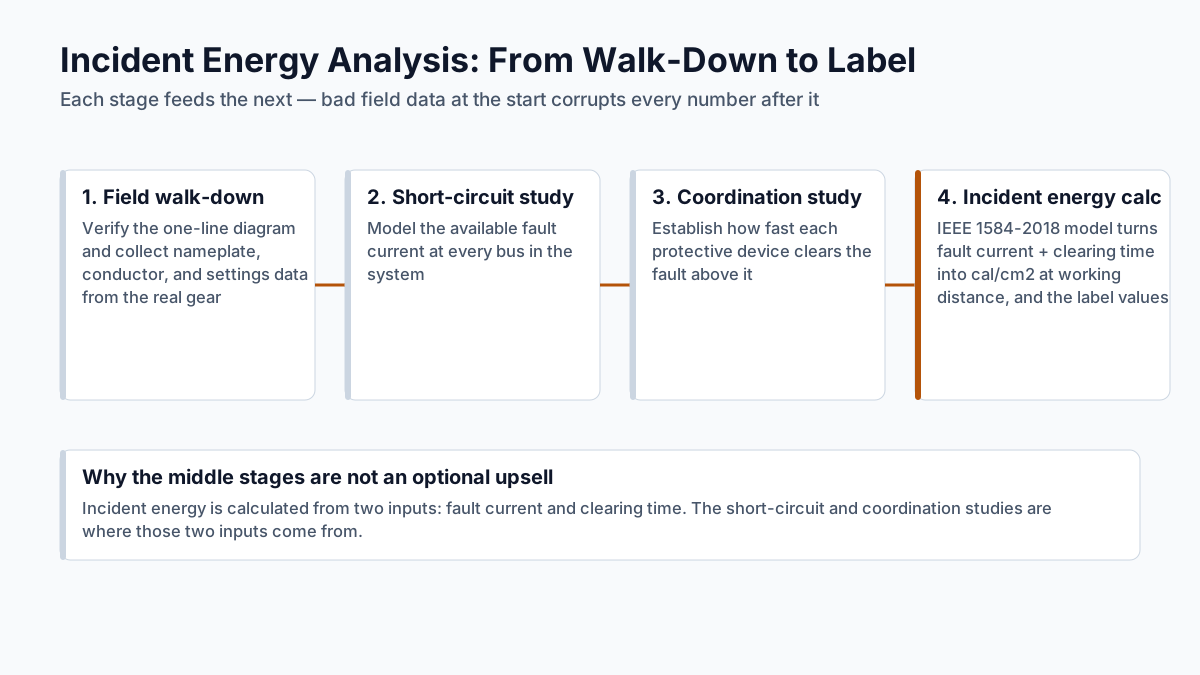
The energy model consumes the output of two studies it does not contain. It needs the available short-circuit current at each bus, which comes from a short-circuit study. It needs the clearing time of the device upstream of the arc, which comes from a protective device coordination study. Neither one lives inside IEEE 1584-2018, and neither can be skipped, because the calculation has nowhere else to get those inputs.
If you are collecting proposals, that is where they differ from one another. Labels alone are the last step of a three-part study, not the study, so the useful question about a quote is what produced the numbers being printed. PPE selection sits outside the guide too, which is why NFPA 70E rather than IEEE is the document that tells a worker what to wear at a given cal/cm² value. A proposal that never mentions short-circuit or coordination work is either folding it in silently or leaving the model to run on assumptions.
How does an incident energy analysis actually get done?
The work runs in a fixed order because each stage feeds the next. Nothing can be calculated until the field data is real, and nothing can be labeled until the calculation is finished. Most of the schedule burden lands at the front, in your electrical rooms, with your people opening gear.
| Stage | What happens | On site or off |
|---|---|---|
| 1 | Field data collection, the walk-down: every piece of gear in scope opened and recorded, plus the utility's available fault current and the one-line diagram (the single-page schematic showing how power flows from the service to each panel), built from scratch when none exists | On site |
| 2 | Short-circuit study: available fault current established at each bus | Off site |
| 3 | Coordination study: protective device settings and clearing times evaluated device by device | Off site |
| 4 | Incident energy calculation under IEEE 1584-2018, producing a cal/cm² value and arc flash boundary per enclosure | Off site |
| 5 | Labels applied, study report issued, workers trained to read both | A short labeling visit |
Stage 1 is the one worth negotiating hard, because it is the only stage that costs you access to your own equipment. Arc Flash Florida works the walk-down into a facility's existing maintenance windows, so the outages the data collection needs are the outages you were already planning to take.
Stage 1 also sets the ceiling on everything after it. Copying panel schedules that may not match what is actually wired inside the panel is how a study comes out precise and wrong at the same time.
How long does an incident energy analysis stay accurate?
An incident energy value is a snapshot of a system with fixed inputs. Change an input and the real number changes, whether or not anyone reprints the label. In Florida the inputs move for reasons that have nothing to do with a planned electrical project.
Storm season is the obvious one. A plant that ran three weeks on rental generators after a hurricane was running on a different source impedance the entire time, and the utility transformer swapped out after the same storm can change the available fault current at the service permanently. Salt air a few miles off the coast works on contacts and operating mechanisms; a breaker that has not been exercised in a decade can take longer to open than the trip curve the model assumed for it, meaning the device's published clearing time, and clearing time moves incident energy harder than almost any other input. Add a chiller, re-tap a transformer, or change a relay setting during a coordination fix, and the arithmetic behind the label no longer describes the plant. Data-center buildouts and water and wastewater upgrades do this on a schedule.
So the direct answer: nothing expires on a date. What retires an analysis is a change to its inputs. Because OSHA's PPE rule at 29 CFR 1910.132(d) requires the employer to assess the workplace for hazards needing PPE, select PPE that protects against what was assessed, and certify in writing that the assessment was done, a certification describing gear that is no longer installed has stopped documenting the workplace. Reopen the study when the system changes, and keep a standing review interval so the changes nobody wrote down get caught anyway.
Can in-house staff run any of this?
Plenty of it, yes. In-house safety and maintenance people can host and schedule the walk-down, keep PPE inventory and inspection records, run training logistics, and maintain the one-line diagram once it exists. The incident energy calculation itself is engineering analysis: it turns on judgment about fault current, device curves, and how an arc behaves in a given enclosure, and it produces a number a worker will stand in front of.
OSHA never uses the phrase "arc flash study." The PPE rule above is the general hook, and for electric utility work it gets specific: 29 CFR 1910.269 Appendix E names IEEE Std 1584 as an acceptable method for the reasonable estimate of incident heat energy that has to be made before energized work. The obligation belongs to the employer either way, not to whoever ran the math.
Most facilities are missing several of the pieces NFPA 70E asks for: current labels, a study report somebody can actually find, an up-to-date one-line diagram, training records, a written electrical safety program. That is normal. It is also fixable in one planned pass, and the order above is the order that gets there fastest.
Frequently asked questions
Is arc flash analysis required by OSHA?
OSHA does not name an "arc flash study" in its PPE rule, but 29 CFR 1910.132(d) requires employers to assess the workplace for hazards that make PPE necessary, select PPE that protects against the assessed hazard, and certify in writing that the assessment was performed. Arc flash is a recognized hazard of that kind, so the assessment obligation applies whatever you call the resulting document. For electric utility work, 29 CFR 1910.269 Appendix E lists IEEE Std 1584 as an acceptable method for the incident heat energy estimate that must be made before energized work.
What unit is used to measure incident energy?
Incident energy is quantified in calories per square centimeter (cal/cm²), the thermal energy delivered to a surface at a specified working distance from the arc source. The distance is part of the measurement, so a cal/cm² figure quoted without its working distance is incomplete: the same arc yields a lower value farther from the enclosure and a higher one closer in.
How often does an incident energy analysis need to be updated?
There is no expiration date on the calculation itself. What retires it is a change to any input the model used, and those changes are not always visible on the floor: a new relay setting or a revised breaker trip curve moves results without a single piece of equipment looking different. Utility service changes, added generation, transformer re-taps, and new large loads all have the same effect.
Does an arc flash study cover every panel in the building?
Not automatically. Scope is set per piece of equipment, and IEEE 1584-2018 models three-phase AC systems from 208 V to 15 kV, so single-phase AC and DC systems such as battery strings, UPS DC buses, and solar DC fall outside its models and need separate treatment. Confirm which enclosures are in scope before the field work starts, because gear left off the walk-down list ends up with no label and no calculated value.
Sources reviewed
- NFPA — "Using the Incident Energy Analysis and Arc Flash PPE Category Methods" (blog, by Christopher Coache, NFPA Senior Electrical Engineer) NFPA 70E requires exactly one of the two PPE-selection methods per piece of equipment (never both), and Section 130.7(C)(15) governs the arc-flash PPE category method and bars deriving a category from an incident energy analysis.
- IEEE Standards Association — IEEE 1584-2018, IEEE Guide for Performing Arc-Flash Hazard Calculations (official standard page) Scope and purpose of IEEE 1584-2018: mathematical models for arc-flash hazard distance and incident energy for three-phase AC systems 208V–15kV; excludes single-phase, DC, short-circuit studies, OCPD coordination, and PPE recommendations.
- OSHA — 29 CFR 1910.132(d), Personal Protective Equipment, Hazard assessment and equipment selection Employers must assess the workplace for PPE-necessitating hazards, select adequate PPE, and certify the hazard assessment in writing.
- OSHA — 29 CFR 1910.269, Appendix E (Incident energy estimations for electric utilities) IEEE Std 1584 is listed as an acceptable method for the 'reasonable estimate' of incident heat energy OSHA requires utilities to make before energized work.
- Power & Cables — "IEEE 1584 Arc Flash Standard: An Interview with Jim Phillips P.E., MIET" Source of the attributed Jim Phillips quotes on how the 2018 model's enclosure-size and polynomial-based calculations changed incident energy results versus the 2002 edition.
- Tyndale USA — "130.5(F) Incident Energy Analysis Methods" (NFPA 70E section-by-section explainer) Secondary corroboration only (unverified against NFPA's own text) that 130.5(F) offers the choice of PPE-selection method and 130.5(G) is the incident-energy PPE table — flagged in claims, do not cite as sole authority for the letter-subsections.