An arc flash study is an engineering analysis of a facility's electrical distribution system that calculates, for every piece of equipment a worker might open, how much thermal energy an arcing fault would release at working distance (incident energy, measured in calories per square centimeter, or cal/cm²) and how far that hazard reaches (the arc flash boundary). NFPA 70E calls it an arc flash risk assessment. It produces three things you can hold: the warning labels on your equipment doors, the personal protective equipment (PPE) selections those labels drive, and the written record that satisfies an employer's hazard-assessment duty under OSHA.
Picture a maintenance lead in front of a 480-volt motor control center (MCC), the tall metal cabinet full of stacked compartments called starter buckets, each bucket holding the contactor and overload protection for one motor. One bucket has failed, the line is running, and shutting the whole MCC down costs a shift. Without a study, "is this safe to open live" is a guess dressed up as experience. With one, the label on that door states the incident energy at a stated working distance and the arc flash boundary in feet and inches, which decides what the technician wears and whether the job should be done energized at all.
What does the study calculate?
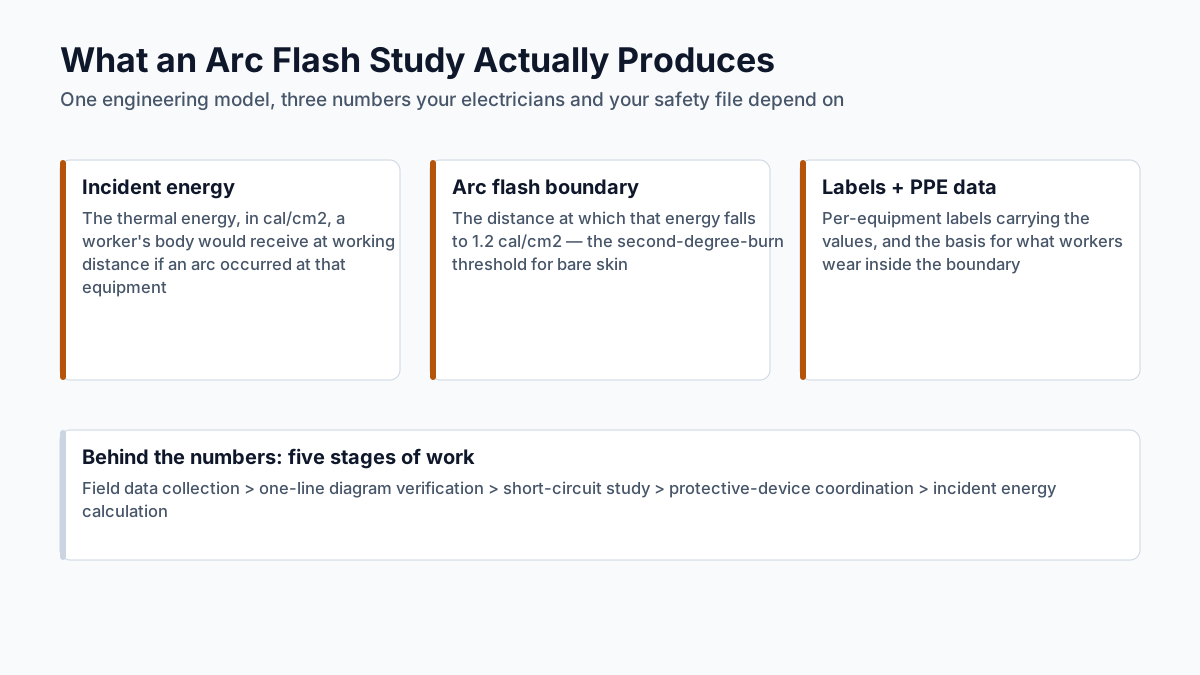
Two numbers per piece of equipment, plus the conditions behind them. Incident energy is the heat that would land on a worker standing at a defined working distance during an arcing fault, expressed in cal/cm². The arc flash boundary is the approach distance at which that energy has dropped to the burn-onset threshold, so anyone standing inside that line during an arc is in the thermal hazard. Everything else in the report exists to make those two numbers defensible.
The calculation method comes from IEEE 1584-2018, whose published scope covers three-phase AC equipment and conductors from 208 V to 15 kV and explicitly excludes single-phase AC systems, DC systems, short-circuit and overcurrent-coordination studies, and PPE recommendations.
That exclusion list is worth reading twice, because it describes what buyers actually need. IEEE 1584 tells an engineer how to convert fault current and clearing time into incident energy. It does not tell them your available fault current, judge whether your breakers trip in the right order, or pick your gear. Those are separate scopes of work, and a complete engagement includes them, because the incident-energy number is meaningless without them.
The 2018 method also made the answer sensitive to physical details the older method ignored, including electrode configuration (how the conductors are arranged, and which direction the arc blows) and enclosure size. Two panels with identical fault current and identical clearing time can carry different labels because one is a shallow surface-mounted box and the other is a deep switchgear cubicle.
What are the five stages of the work?
The work runs in a fixed order because each stage feeds the next. Stage one is the only one that happens in your building; the rest happen inside the model built from it. Shortcut stage one and the report comes back with numbers nobody trusts.
| Stage | What happens | What it produces |
|---|---|---|
| 1. Field data collection | A walk-down from the utility service to the last panelboard: nameplates, conductor sizes and lengths, breaker and fuse types, relay settings, transformer impedance | An accurate model of what is installed today, plus a one-line diagram (the single-page map of how power flows through the building) if none exists |
| 2. Short-circuit analysis | Computes maximum and minimum available fault current at every bus (the common set of conductors inside a piece of gear that everything downstream connects to) | The fault current every later stage depends on |
| 3. Protective device coordination | Models how fast each breaker, fuse, and relay clears a fault, and whether the closest device opens first (selectivity) | Clearing times, and a list of settings worth changing |
| 4. Incident energy analysis | Applies IEEE 1584-2018 at each bus using fault current, clearing time, working distance, electrode configuration, and enclosure geometry | Incident energy in cal/cm² and an arc flash boundary per location |
| 5. Labeling and reporting | Labels printed and applied per NFPA 70E 130.5(H), with the calculations, the one-line, and the assessment record delivered together | Field-ready labels and the documentation an inspector or an insurer asks to see |
The min/max pair in stage two is the part most people read past, and it often decides the answer. Maximum fault current is the obvious hazard. Minimum fault current is frequently the worse one, because a lower arcing current can sit just under a breaker's instantaneous trip threshold and burn for a full second instead of clearing in a few cycles. Longer burn, more energy delivered, higher number on the label. That is why the worst incident energy on a site is not reliably at the highest voltage. OSHA makes the same point from the injury side: it describes an electric arc as a type of electrical explosion that can exceed 35,000°F, and notes that most arc flash burns come from the arc igniting the worker's clothing rather than from the arc itself.
Does it matter which edition the study was built on?
Yes. IEEE 1584-2018 replaced the 2002 edition, and the two methods do not produce the same incident energy for the same equipment. Jim Phillips, P.E., Vice-Chair of the IEEE 1584 Arc Flash Working Group and a Technical Committee member on NFPA 70E, draws the line precisely: "The overall risk assessment process is the same as before. i.e. Arc rated clothing and PPE are selected with an arc rating sufficient for the calculated incident energy."
What changed sits underneath that process. "However, the difference is with the incident energy calculations using IEEE 1584," Phillips says. "The calculations and modeling have changed dramatically." A report built on 2002 math and one built on 2018 math are not interchangeable documents, even when the equipment has not moved an inch.
NFPA 70E's next edition, the 14th, is in revision now, with issuance expected in late 2026 into 2027. OSHA measures a facility against current recognized practice, not against whichever edition your last report cited, so the edition printed on the cover is worth checking before somebody else checks it.
What makes it required?
NFPA 70E Section 130.5 requires an employer to perform an arc flash risk assessment before work is done on energized equipment that has not been put into an electrically safe work condition. The assessment identifies the hazard, estimates the likelihood of an incident, determines the potential severity of injury, and then drives protection by one of two methods: the incident energy analysis method in 130.5(G) or the PPE category method in 130.7(C)(15), never both on the same equipment. 130.5(H) sets what the resulting label must show.
NFPA 70E is a voluntary consensus standard, not a federal regulation. OSHA has said in standard interpretations that it has not conducted rulemaking to adopt 70E's specific requirements, and that it has no arc-flash label rule of its own. None of that makes the exposure theoretical. OSHA treats an industry consensus standard as evidence that a hazard is recognized and correctable under the General Duty Clause, and it separately enforces 29 CFR 1910.132(d), which requires an employer to assess the workplace for hazards, select PPE that protects against what the assessment found, and certify that assessment in writing.
Which events oblige you to commission a study, and how long a finished one stays current, are separate questions with their own answers. This page is the definition.
What does stage one turn up in a coastal plant?
Field data collection is where Florida conditions land in the model. Storm work leaves a trail: switchgear replaced after a hurricane, a utility service upgraded to a larger transformer, a permanent generator and transfer switch added after a week of running on rentals. Each of those changes available fault current, and none of them update the label on the door by itself.
Condition matters as much as configuration on the coast. A fault does its damage in a few cycles; corrosion does comparable damage to a bolted joint over years, pitting and loosening terminations until contact resistance climbs. At a barrier-island wastewater plant on the Atlantic side, the ingredients arrive together: salt air, hydrogen sulfide off the headworks, and gear that cannot be shut down because the lift stations keep pumping through the afternoon storms. A walk-down there means opening cabinets nobody has opened in years, and the model has to reflect what is inside them now, not what a drawing from the 1990s claims.
That is the part a facility can plan around. Arc Flash Florida handles the whole job in one engagement, including building a one-line diagram for sites that no longer have a current one, and the field walk-down is scheduled to fit your production schedule rather than interrupt it.
The end state is the same in every building: a current label on every piece of gear, calculations on file behind it, and nobody standing in front of a closed door guessing.
Frequently asked questions
Are arc flash studies legally required?
NFPA 70E 130.5 requires the risk assessment, but 70E is a voluntary consensus standard and OSHA has stated it never adopted 70E's specific requirements through rulemaking. OSHA enforces through the General Duty Clause, treating a consensus standard as evidence the hazard is recognized, and through 29 CFR 1910.132(d), which requires a written certification of the hazard assessment identifying the workplace evaluated, the person certifying it, and the date.
What is arc flash in simple terms?
OSHA describes an electric arc as a type of electrical explosion that can exceed 35,000°F, and notes that most arc flash burn injuries come from the arc igniting a worker's clothing rather than from the arc itself. Severity tracks available fault current, how fast the protective device clears, and working distance, not voltage alone.
What has to appear on an arc flash label?
NFPA 70E 130.5(H) specifies the contents: nominal system voltage, the arc flash boundary, and either the incident energy with its working distance or the PPE category, plus the date the assessment was performed. A label missing the date or the working distance behind the incident energy is not a compliant label.
How much does an arc flash study typically cost?
Scope, not square footage, drives the number. The countable factors are how many buses have to be modeled, how many utility services and generators feed them, the condition and accessibility of the gear during field data collection, and whether a current one-line diagram exists or has to be built from scratch. Ask any provider to quote against a bus count so you are comparing the same scope.
Sources reviewed
- IEEE 1584-2018 — IEEE Guide for Performing Arc-Flash Hazard Calculations (official standard page) Defines what an arc flash study calculates (incident energy, arc flash boundary), its voltage scope (208V-15kV, three-phase AC), and what it excludes (single-phase, DC, coordination studies, PPE selection).
- OSHA — Electrical, Electric-Arc Flash Hazards Describes arc flash as an electrical explosion exceeding 35,000°F and notes most burn injuries result from ignited clothing, not the arc itself; references 29 CFR 1910.333 and 1910.269.
- OSHA — 29 CFR 1910.132, General requirements (PPE hazard assessment) Requires employers to assess the workplace for hazards, select PPE accordingly, and document the assessment with a written certification.
- OSHA Standard Interpretation, 2003-07-25 — Relevance of NFPA 70E industry consensus standard to OSHA requirements OSHA treats NFPA 70E as evidence a hazard is 'recognized' and correctable under the General Duty Clause, not as a directly enforced regulation.
- OSHA Standard Interpretation, 2006-11-14 — Arc-flash warning signs and NFPA 70E-2004 compliance OSHA has no specific arc-flash label regulation and has not adopted NFPA 70E's requirements through rulemaking; NFPA 70E functions as guidance.
- NFPA 70E, Standard for Electrical Safety in the Workplace (official product page) NFPA 70E is the standard specifying arc flash risk assessment, PPE, and equipment labeling requirements (Section 130.5 including 130.5(H) labeling, and 110.5 written electrical safety program).
- NFPA — Free access to NFPA codes and standards NFPA 70E's full text is readable free online through NFPA's official free-access portal, the counterpart primary source for section-level verification.
- Power and Cables — IEEE 1584 Arc Flash Standard interview with Jim Phillips, P.E. Attributed expert commentary on how the IEEE 1584-2018 revision changed incident-energy calculations while the overall PPE risk-assessment process stayed the same.