An arc flash study is required before a worker examines, adjusts, services, maintains, or troubleshoots electrical equipment operating at 50 volts or more while that equipment is energized. If energized work is planned and no current study covers the gear, the requirement is active now, not at some future renewal date. OSHA enforces it through its written hazard-assessment rule and the General Duty Clause, and NFPA 70E is the method employers use to satisfy both.
Picture a motor control center, the steel cabinet lineup whose drawer-like compartments, called buckets, each feed and protect one motor. A conveyor keeps tripping. Production will not stop for it, so an electrician pulls the drawer out while the lineup is still live. Whether that is a controlled task or a coin flip comes down to what is printed on the door of that cabinet, and what is printed there comes out of a study.
Does OSHA require an arc flash study?
OSHA never uses the phrase "arc flash study," and 29 CFR 1910 Subpart S does not spell out heat-exposure calculations or equipment labeling for general industry. The requirement arrives two other ways. 29 CFR 1910.132(d) requires every employer to assess the workplace for hazards, select PPE based on that assessment, and certify the assessment in writing. Section 5(a)(1) of the OSH Act, the General Duty Clause, separately requires a workplace free from recognized hazards that are causing or are likely to cause death or serious physical harm.
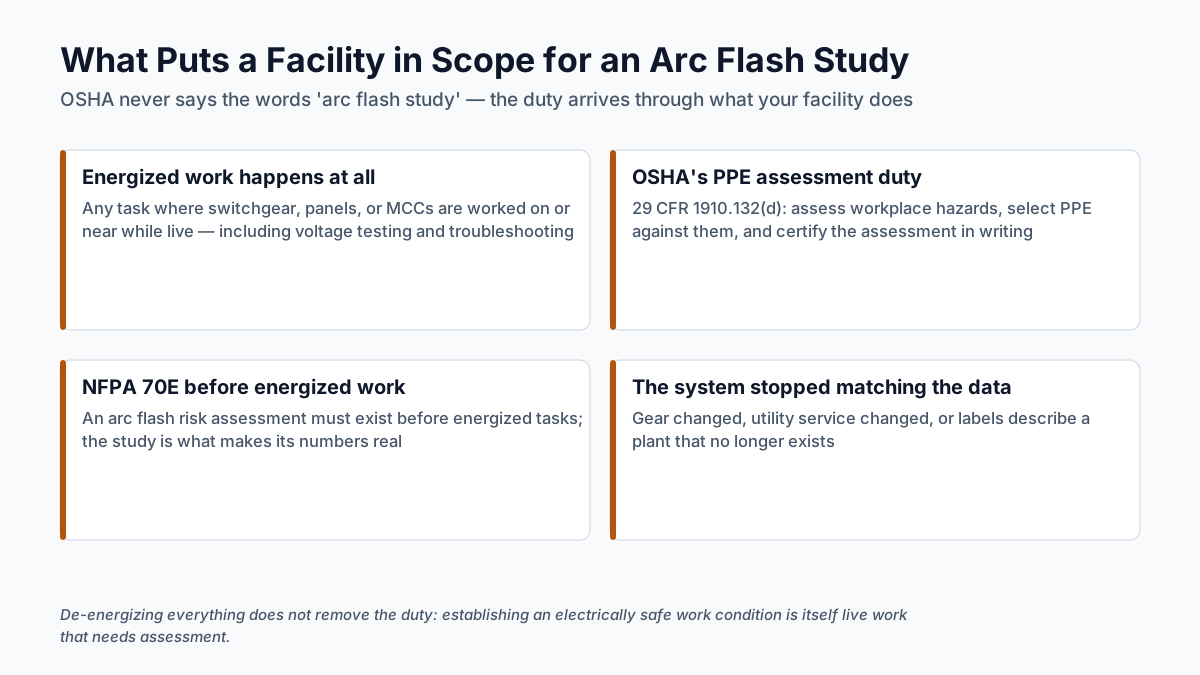
Arc flash is a recognized hazard anywhere energized equipment gets examined, adjusted, serviced, or maintained. In November 2024, in its first major arc flash guidance update in roughly two decades, OSHA published Protecting Employees from Electric-Arc Flash Hazards (OSHA 4472-11), which recommends conducting an arc flash study for employers whose workers may be exposed to electrical hazards and aligns its language with the 2024 edition of NFPA 70E.
NFPA 70E itself is a consensus standard, not a statute. OSHA measures facilities against it under the rules above, and it usually does that after an incident, a complaint, or an audit. That timing is the reason gaps stay invisible until the worst possible week.
What conditions put your facility in scope right now?
Any one of the conditions below is enough to require a study, and they are not all about paperwork. The first three describe a facility that has never had the analysis done or can no longer prove it. The last two describe a system that has moved out from under the analysis it did have.
| Condition | Why it puts you in scope |
|---|---|
| An energized task at 50 volts or more is planned: troubleshooting, adjustment, servicing, or maintenance on live equipment | PPE cannot be selected without a hazard assessment, and there is nothing to certify in writing until one exists |
| No study on file for that equipment | Nothing establishes the calculated heat exposure, the safe approach distance, or the PPE rating for anyone standing in front of the gear |
| Labels missing, unreadable, or with no report behind them | A label only reports numbers a study produced. Without the underlying report, the numbers cannot be verified or defended |
| Equipment that never gets a shutdown window, meaning there is no hour of the year it can be switched off | Work on it will be energized by definition, so the assessment is required rather than optional |
| The system no longer matches its one-line diagram, the map of how power flows from the utility through each breaker to each load | A model built on a wrong one-line returns wrong numbers, which is worse than no numbers, because people trust them |
| A major system modification since the last study: a transformer swap, a change in utility fault current, a breaker replacement or setting change, added load, two power buses (the shared conductors feeding a group of breakers) connected together, or a storm-season generator feed made permanent | The existing study described the system as it was before the change. Our companion post on how often a study is required covers the review cycle and what an interim review has to include |
That last row is different in kind from the others. It is a physical change to the building, and it can land four months after a finished study was delivered and filed. When one does, the study on file stopped describing the building on the day the change was made. The requirement to have accurate numbers stayed exactly where it was. The study just stopped meeting it.
What does NFPA 70E require before energized work?
NFPA 70E covers two electrical hazards, shock, which starts around 50 volts, and arc flash, defined at incident energy of 1.2 cal/cm² or greater at working distance. The standard requires a documented electrical safety program with a risk-assessment procedure in it. The arc flash risk assessment has to identify the hazard, estimate the likelihood and severity of an incident, and determine the protective measures, including PPE, before anyone opens the equipment.
Incident energy is the heat that would land on a worker standing at normal working distance if an arc occurred, measured in calories per square centimeter. OSHA's 2024 guidance uses the 1.2 cal/cm² figure (5.02 J/cm²) to define the arc flash boundary, the distance from the equipment at which that energy level is reached.
NFPA 70E allows two routes to those answers: the PPE category method, which uses table lookups, or an incident energy analysis. The analysis route runs on IEEE 1584-2018, the guide for performing arc-flash hazard calculations, which came out of the analysis of more than 1,800 real arc tests over roughly fifteen years of development and replaced the 2002 edition. That is the engineering behind the number on the label.
The standard also expects the assessment to be kept current rather than filed once, with a recurring review and an update after a major system modification. The review cadence itself is the subject of the companion post noted above.
Can you skip the study by de-energizing everything?
De-energized work is the strongest control available, and a facility that can genuinely take equipment out of service for maintenance carries far less exposure. But OSHA 4472-11 defines an electrically safe work condition per NFPA 70E, and reaching one is a sequence of steps performed on equipment that is still presumed live until testing proves otherwise. Opening the disconnect and testing for absence of voltage are themselves tasks on energized gear. De-energized is a verified condition, not a policy statement.
Some equipment never gets a shutdown window at all. A hospital's essential feeders, a municipal water plant's pump distribution, a data center's power path. Those sites run energized work because the alternative is stopping something that cannot stop.
What makes this harder at Florida facilities?
Two conditions common in Florida change either the system being modeled or the data available to model it. Salt air near the coast degrades enclosures, contacts, and, in the practical sense that matters for a study, nameplates. A study is built from nameplate data: transformer impedance and rating, breaker type and trip settings, conductor size and length. On a switchgear lineup a few miles off the water near Fort Myers or St. Petersburg, that plate can be pitted past reading, and the data has to be recovered from records, from the manufacturer, or by measurement.
The second is storm season. Generator tie-ins, rental units feeding a lift station for six weeks, and temporary service arrangements do not always come back out. When a temporary feed becomes a permanent transfer switch, the utility fault current and the protective device coordination the study assumed have both moved. Add Florida's summer load profile, where a wastewater plant or a data hall has essentially no outage window between June and September, and energized work becomes the normal case rather than the exception.
What can in-house staff handle, and what needs an engineer?
Plenty of the program belongs to your own people. Maintenance and safety staff can photograph nameplates, pull breaker settings, run PPE inventory audits, schedule and track NFPA 70E qualified and unqualified training, and keep the one-line marked up as changes happen. Doing that work well shortens the field phase and keeps scope from growing. What it does not cover is the analysis: modeling short-circuit current, protective device clearing times, and incident energy at each location takes a licensed professional engineer working on your specific system, because those values depend on your utility, your conductors, and your settings, not on a category table.
Most facilities are missing several of the pieces the standard asks for. Current labels, an accurate one-line, a written electrical safety program. That is normal, and it is not a verdict on how the plant is run. It is what happens when a consensus standard gets measured against a building that has been added to for thirty years.
If energized work is on the schedule and nothing current covers it, the answer to when is now, and the practical fix is one planned pass rather than a scramble: field data collection worked into the maintenance windows you already have, the engineering, the labels, the training. Arc Flash Florida handles that whole scope in one engagement, including building the one-line diagram for facilities that do not have a current one.
Frequently asked questions
Are arc flash studies required by OSHA?
OSHA does not use the phrase "arc flash study," but 29 CFR 1910.132(d) requires every employer to assess workplace hazards, select PPE from that assessment, and certify it in writing, and Section 5(a)(1) of the OSH Act requires a workplace free from recognized hazards likely to cause death or serious physical harm. OSHA's November 2024 guidance, Protecting Employees from Electric-Arc Flash Hazards (OSHA 4472-11), explicitly recommends conducting an arc flash study for employers whose workers may be exposed to electrical hazards.
What are the arc flash study requirements under NFPA 70E?
NFPA 70E requires a documented electrical safety program that includes a risk-assessment procedure. The arc flash risk assessment must identify the hazard, estimate the likelihood and severity of an incident, and determine the protective measures and PPE needed before energized work begins. Employers may use either the PPE category method or an incident energy analysis, which is performed using IEEE 1584-2018.
Do we still need a study if we never work on equipment while it is energized?
Usually yes. Reaching an electrically safe work condition, as defined in OSHA 4472-11 per NFPA 70E, requires opening the disconnect and testing for absence of voltage on equipment that is presumed energized until proven otherwise. Those steps are themselves tasks performed on live gear, so the hazard assessment still applies.
Does the requirement really begin at 50 volts?
NFPA 70E treats shock as a hazard starting around 50 volts and arc flash as a hazard at incident energy of 1.2 cal/cm² or greater at working distance. Equipment operating at 50 volts or more that will be examined, adjusted, serviced, or maintained while energized is in scope, regardless of how routine the task feels.
Sources reviewed
- OSHA -- 29 CFR 1910.132(d), Hazard Assessment and Equipment Selection Employers must assess the workplace for hazards and select PPE (including for arc flash) based on that documented assessment.
- OSHA -- OSH Act of 1970, Section 5 Duties (General Duty Clause) Employers must furnish a workplace free from recognized hazards likely to cause death or serious physical harm (5(a)(1)) and comply with promulgated standards (5(a)(2)).
- OSHA Publication 4472-11 (2024) -- Protecting Employees from Electric-Arc Flash Hazards OSHA's 2024 guidance recommends conducting an arc flash study, aligns with NFPA 70E 2024, and defines the arc flash boundary at 1.2 cal/cm^2 per NFPA 70E.
- NFPA -- Learn More About NFPA 70E (official overview) NFPA 70E covers two electrical hazards -- shock (starting ~50V) and arc flash (1.2 cal/cm^2+) -- and requires a risk-assessment procedure as part of an electrical safety program.
- IEEE Standards Association -- 1584-2018 IEEE Guide for Performing Arc-Flash Hazard Calculations IEEE 1584-2018 is the engineering guide used to calculate incident energy and arc flash boundary distances, updating the 2002 edition after analysis of 1,800+ arc tests.